

Lawns are often blamed for wasting water, when in fact it is how they are watered that is primarily to blame. Over half of the water applied to our lawns is wasted, and the majority of this is in our control. Here are three ways we waste water and how to avoid waste and create a healthier beautiful lawn.
Applying Too Much Water 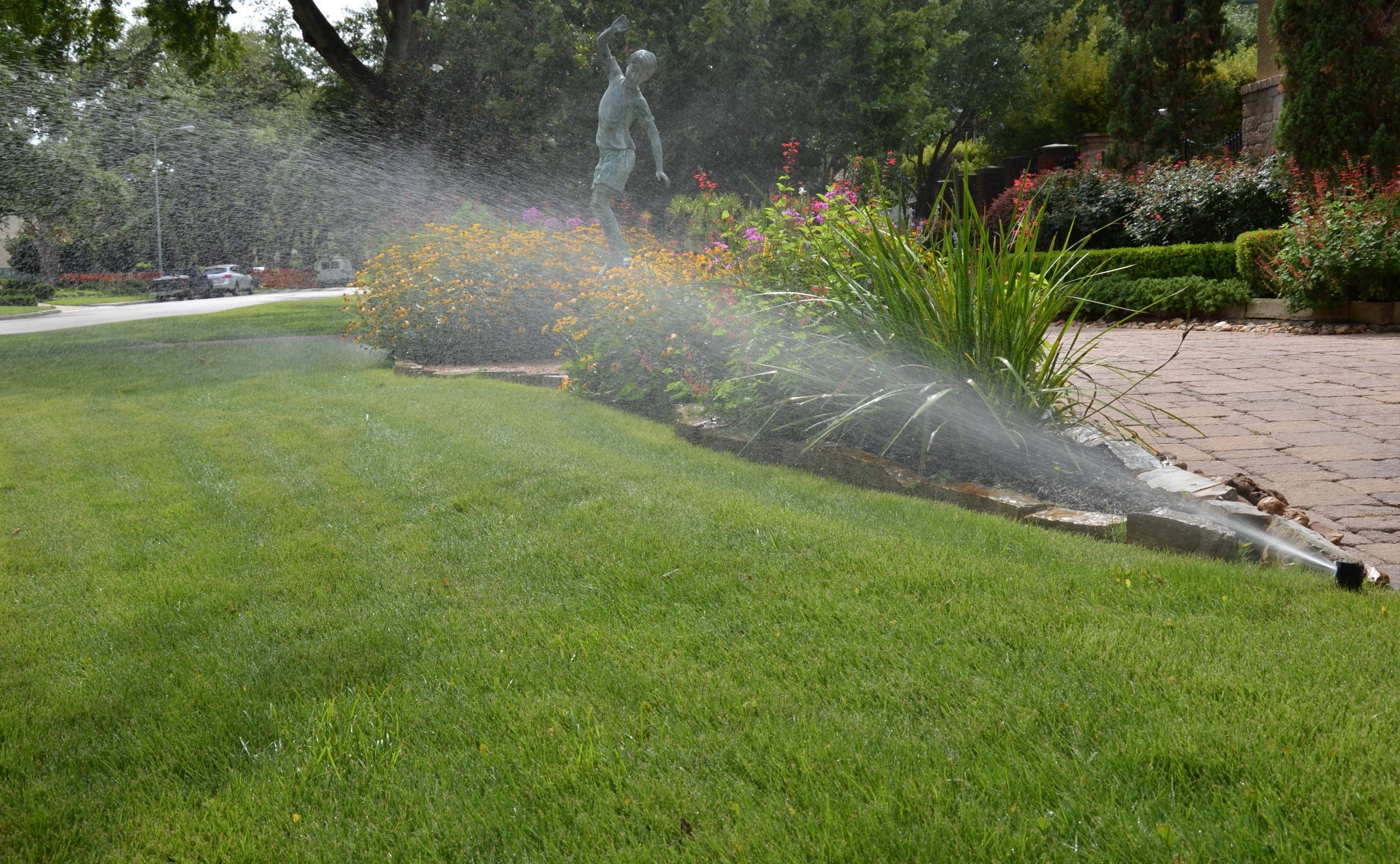
A lawn in our region of the state needs about 1/2″ of rainfall or irrigation per week in spring and fall, and 1″ in summer. That said, it is better to irrigate based the water used by the lawn, known as evapotranspiration (ET), which is computed based on temperature, humidity, solar radiation, and wind speed. A lawn needs only 60% of its ET to maintain good appearance and health.
Most lawns receive much more water than the grass needs in our region of the state. For example, in a 3-year study of 800 homes in College Station found that homes that applied 70% of ET (more than required for good turf quality and health) used over 41,000 gallons a year less that those that didn’t water based on ET!
Over-application causes increased disease problems and nutrient leaching, and results in shallow rooted turf due to a lack of oxygen in the soil. Wasting the drinking water you paid for by applying more than the lawn needs is also a waste of money! Additionally in most areas your sewer bill is based on total water use making wasting water even more expensive.
The Water My Yard program by the Texas A&M AgriLife Extension Service is a free service that uses local weather data in sponsored areas to provide free weekly watering advice tailored to your area. This data is collected from an extensive network of local weather stations and rain gauges, which allow experts to send customized weekly water advice for your specific lawn and irrigation system. This is sent directly to you via a weekly email.
GardenLine listeners are fortunate that all of Harris, Galveston, Ft. Bend and Brazos Counties are among the many areas served by local Water My Yard weather stations. Go to https://www.watermyyard.org for more info and to sign up for free email notifications.
Other ways to avoid over irrigating include an inexpensive rain switch, which prevents your system’s sprinklers from running during and a few days after a rain, and a faucet timer for those who irrigate with hose end sprinklers.
Applying Too Little, Too Often
Deep, infrequent watering is the most effective and efficient way to create a deep rooted, healthy lawn. Consider this, applying 1/3″ of water three times a week uses the same amount as applying 1″ once per week, but doesn’t wet the soil as deeply. Light, frequent irrigations increase the percentage lost to evaporation, increase disease problems, and result in shallow-rooted turfgrass that lacks heat and drought resilience.
To wet your soil to a depth of about 6″ takes about 1″ of water for clay soil, 3/4″ for a loam, and 1/2″ for sandy soil. For a quick check of how deep an irrigation wet your lawn, wait an hour or so after irrigating and then push a long screwdriver down into the soil. When it hits dry soil, it will be very difficult to push the screwdriver past that point.
To determine how long it takes to apply the desired amount of irrigation, set several rain gauges, or straight-sided cans such as tuna fish or cat food cans, around your yard. Run the irrigation for 15 minutes, check the depth in the cans and multiply by 4 to find the amount applied per hour.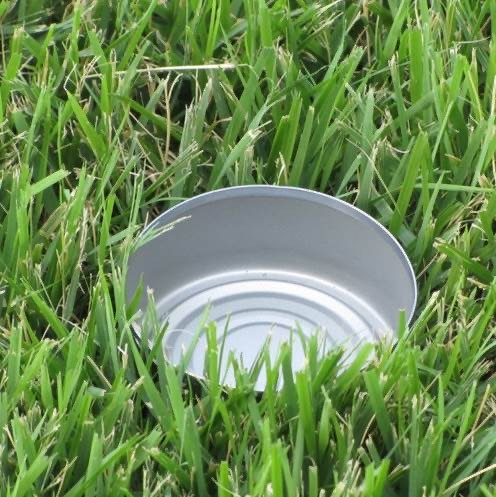
Irrigation systems usually apply water faster than the soil can absorb it, so a “cycle and soak” approach can help avoid runoff. Run the system until just prior to the point of runoff, wait about 45 minutes, then repeat this cycle and soak technique until you’ve applied the desired amount. Most controllers now allow multiple start times to do the work for you.
Inefficient Irrigation Systems
Most irrigation systems lack optimum efficiency and uniformity of coverage. When you do the test using straight sided containers mentioned above, you will likely notice that some areas receive significantly more or less irrigation than others. Since people will run their system long enough to keep the dryest areas adequately watered, this inefficiency can result in a significant waste of water.
Irrigation heads vary in efficiency. Pop up spray heads apply 1.25 to 1.5 inches per hour, much faster than the soil can absorb it. Rotary nozzles apply water at about half that rate and in coarser droplets that minimize drift and evaporative loss, while multi-stream rotors apply about 1/3 inch per hour, also with more efficient droplet size.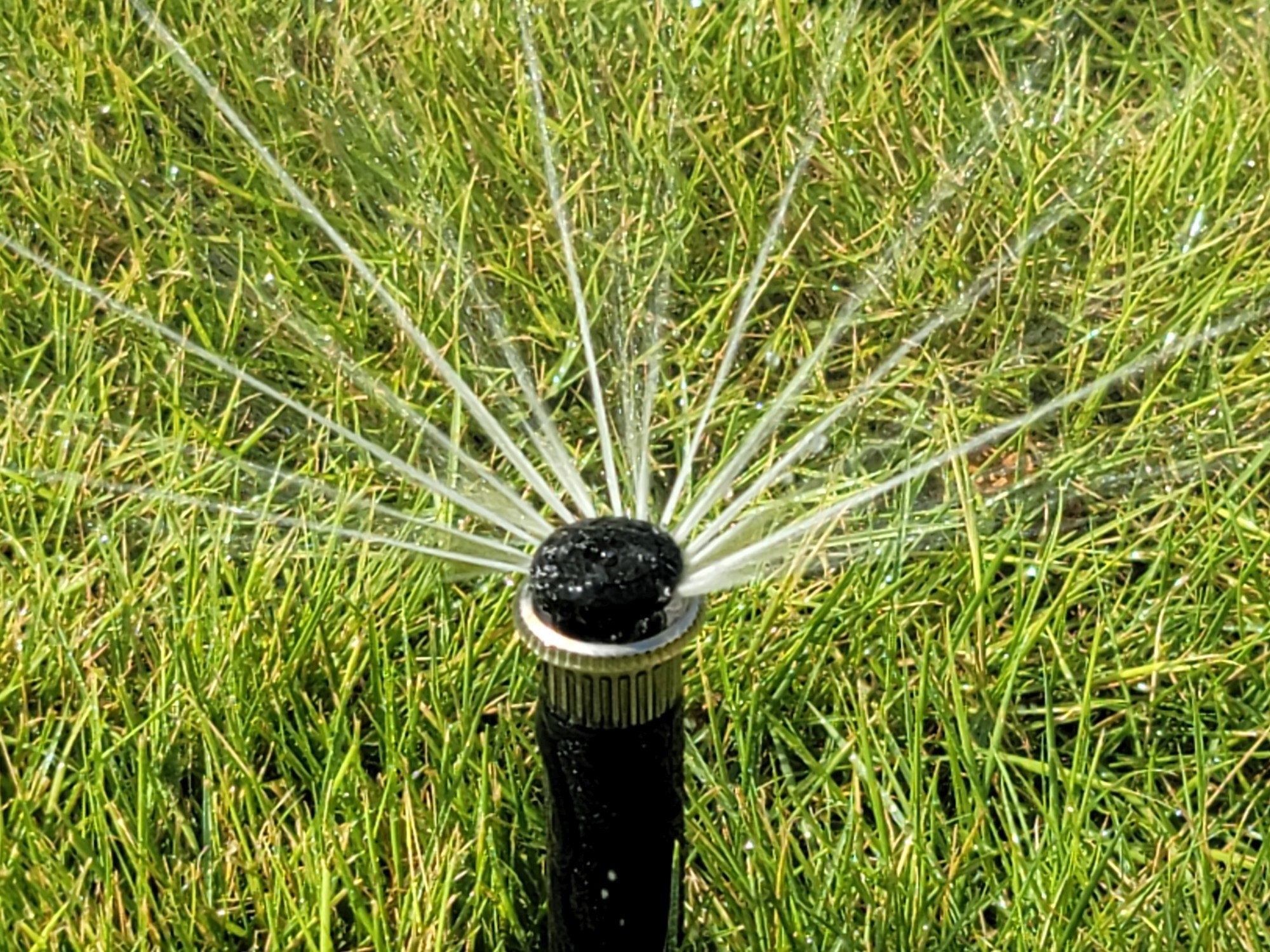
An irrigation company can suggest options for changing out sprinkler heads to improve uniformity and efficiency. In some cases, it may be necessary to relocate and or add additional heads to improve coverage and efficiency.
Uneven application, excessive or insufficient pressure, and damaged or misaligned irrigation heads waste water. A former neighbor of mine’s system was so misaligned that when their system came on it sprayed one side of my car in my driveway. So, I backed into my driveway so their system could wash the other side of my car!
Consider hiring someone to do a complete system audit to determine what needs repair and how to improve efficiency for long term savings. If you are planning on installing a new system, don’t look for the cheapest price offered, but go with a company that understands the newest technologies and focuses on uniform, efficient application.
