

A lack of good light is perhaps the number one mistake gardeners make when starting their own transplants. The results are lanky seedlings reaching toward the light. Such plants will likely break or perform very poorly when planted in the garden. I’ve been there.
With a little knowledge of plant lighting and some reasonably priced fixtures, you can grow great transplants at home. I’ll start with some basics of light science and promise not to be boring!
Three key factors in plant lighting are quality, quantity, and duration. Not all light is equal when it comes to plant growth and development. Our eyes and plants “see” light differently. Home lighting terms like watts, lumens, lux, and “color temperature” are generally not helpful in choosing lighting for plants.
You may recall from back in science class shining a light through a prism and seeing all the colors refracted out into a rainbow. What our eyes see as white is a blend of colors such as violet, blue, green, yellow, orange, and red.
Light wavelengths of primary interest to plants are in the 400-700 wavelength range. Plants can use some of the light in this range for photosynthesis, so it is called photosynthetically active radiation (PAR). Knowing a plant light’s wavelengths in the PAR range allows us to choose the best lighting for our plants. Remember, “Lumens are for humans, PAR is for plants!”
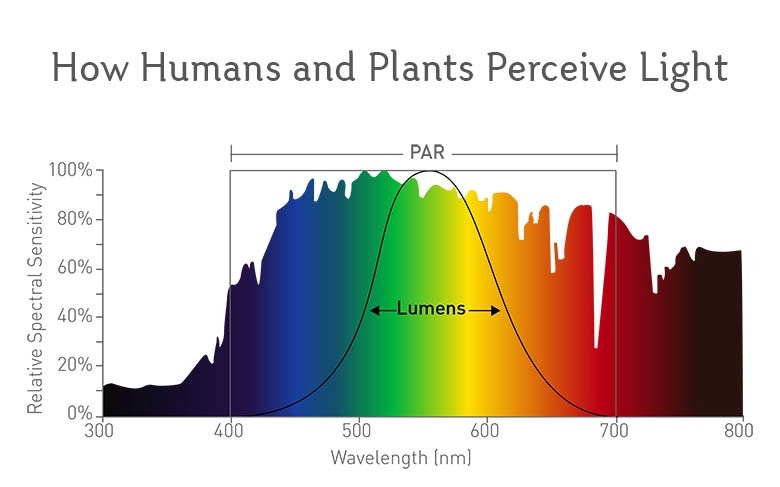 Lighting in the PAR range also drives many other critical factors, including germination, seedling root development, stem lengthening, and the opening and closing of stomates on the leaves, to name a few.
There are many functions of light at various wavelengths, but here is a basic description of blue and red wavelengths. Blue light (400-520 wavelength) optimizes photosynthesis and vegetative growth. Red light (630-660 wavelength) supports stem growth, leaf expansion, flowering, and fruit development. It also promotes seed germination of some species. This is why we sprinkle lettuce seed on the soil surface, so it can be exposed to the red wavelengths needed to germinate well.
Some plant lights focus on only the red and blue spectrums, where most photosynthesis occurs, but plants can use all the PAR spectrum, even green, as well as some UV and infrared wavelengths.
Light quantity is the number of photons hitting the plant leaf surface. The brighter the light, the more photons of the various wavelengths are reaching the leaves. But remember, it’s not just brightness, but the amount of the key wavelengths that plants need most.
The quantity of light for plants is measured as photosynthetic photon flux density (PPFD). I include the terms PAR and PPFD because when you purchase a plant light, the seller will use these terms. If they don’t, it is probably not a quality light, and you may be wasting your money.
Plants need to get enough light over the course of the day. I’ll use a rainstorm analogy. The PPFD is how hard it is raining, while the duration is how long the rainstorm lasts. You can get an inch of rainfall either by a light drizzle for a long time, or a downpour for a short time.
While you can’t blast your plants with a day’s worth of light in a few minutes or run lights 24 hours a day (some plant processes occur best at night), if the light is a bit dimmer than ideal or located a little farther from the plants than ideal, then leaving the light on longer can help ensure the plants get a sufficient total daily supply.
Both incandescent bulbs and fluorescent tubes have been largely replaced by LED lighting. LED bulbs and tubes for the home do not typically produce the spectrum of light best suited for plant growth.
While LED lighting designed for plants is the best option, in a pinch, you can combine a warm white LED tube with a cool white LED tube (note preferred wavelengths above) in a fixture to help supplement a tray of seedlings grown for transplanting. You’ll have to experiment with how low to hang the LED fixture, but these home lighting tubes will likely need to be between 6 and 18” from the plants, depending on their brightness.
 For years, I started seeds under two “shop light” fixtures with one warm white and one cool white tube in each fixture. I suspended those standard fluorescent tubes about 2-4 inches above the plant to get the best results.
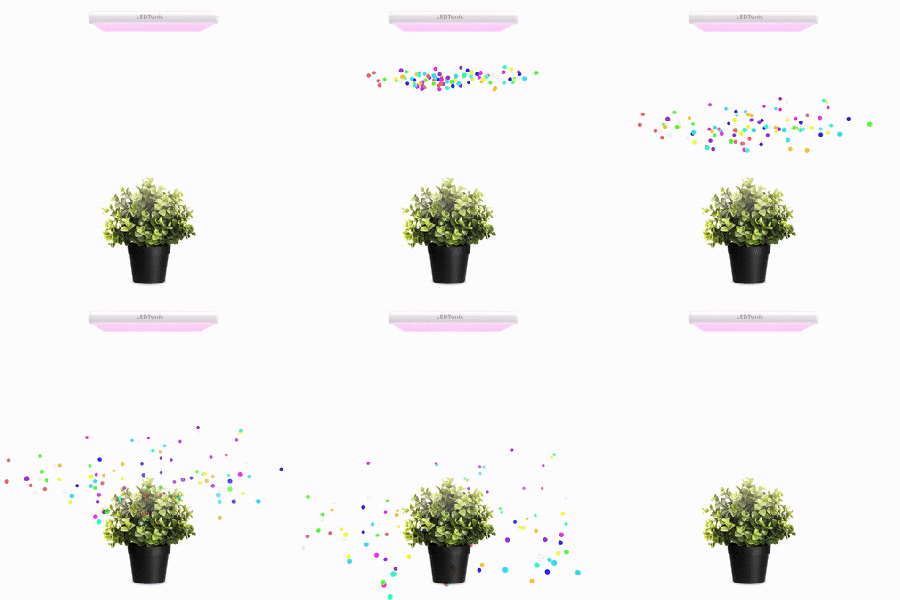
As you move a light farther from a plant, the amount of light reaching the plant’s foliage decreases significantly. For example, if a light is 1 ft away from a plant and you move it to 2 ft away, the light intensity on the leaves is only 25% of what it was 1 ft away. Move it to 3 ft away, and the light intensity is only 11% compared to 1 ft away! I know that seems incorrect, but trust me on this one. You can search for the “Inverse-Square Law of Light” if you want to understand why.
Quality lighting is an investment, and I would recommend that you purchase an LED light that is designed for plants, especially if you wish to grow plants past the normal transplant stage. You should be able to find a good LED plant light in the $60-160 range. The marketplace is confusing with a multitude of options, inadequate information on specifications, and, unfortunately, inaccurate information.
While I am not recommending a company or a specific product, two examples for comparisons to help begin your search are ViparSpectra’s “low-end lights for seed starting” and Spider Farmer’s “Gardening Series”.
Young transplants do very well with lighting running for 14-16 hours a day. It helps to have a timer, such as the type you plug into the wall and then plug the light cord into. This avoids having to turn lights on and off every day!
 Second, it helps a lot to have a reflective wall around the plants to bounce light back into the tray of seedlings. There are fancy growing tents with reflective interiors, but for a few trays, I just attach some aluminum foil to pieces of cardboard to make walls around the setup, and it works great!
I’ve focused this publication on plant lighting for growing transplants in your home. The information is also helpful if you wish to provide supplemental lighting for houseplants. If you want to raise crops all the way to harvest indoors, you’ll want to go much deeper into the topic of lighting. There are more elaborate lighting fixtures and equipment for the serious indoor grower.
For additional information, some lighting manufacturers provide helpful information online. My favorite consumer-level book on the topic is Gardening Under Lights: The Complete Guide for Indoor Growers by Leslie F. Halleck. It is very readable and packed with useful information, both for beginners and those wanting to go deeper into plant lighting.
