

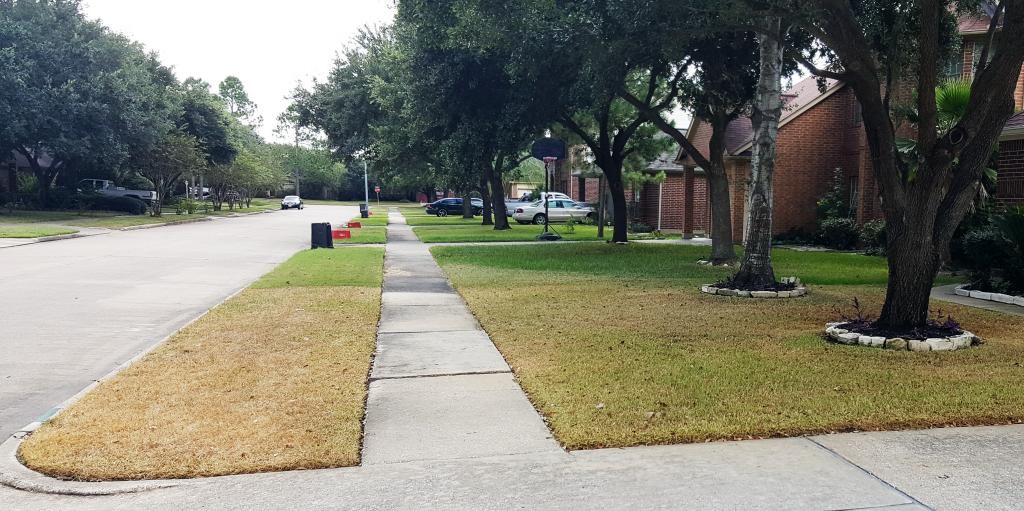
 Tropical sod webworms (TSW) can do significant damage to a lawn in just a few days. Some years they cause serious and widespread damage, while others we see only limited and scattered outbreaks. Even within a neighborhood, the amount of turf damage can vary (see photo). Residents sometimes think they have TSW when they see small moths around their lawn and landscape, but there are numerous small tan/brown moth species in nature.
One characteristic of the TSW moths is when you walk across the lawn they fly out of the turfgrass for a short distance before landing. These moths at rest hold their wings out and back (like the wings on a jet fighter-plane) forming a triangle shape about 3/4″ across.

 Pre-treating for the moths isn’t very helpful since TSW moths do not feed on the turfgrass. These moths appear in mid to late summer and lay eggs in the turf. The caterpillars, which are the destructive stage of the TSW, emerge in 7 to 10 days into the caterpillars. Products applied too soon may not be effective later when the larvae finally hatch and start feeding. Some products such as B.t. only last 1-2 days, while others can persist for a week to over a month.
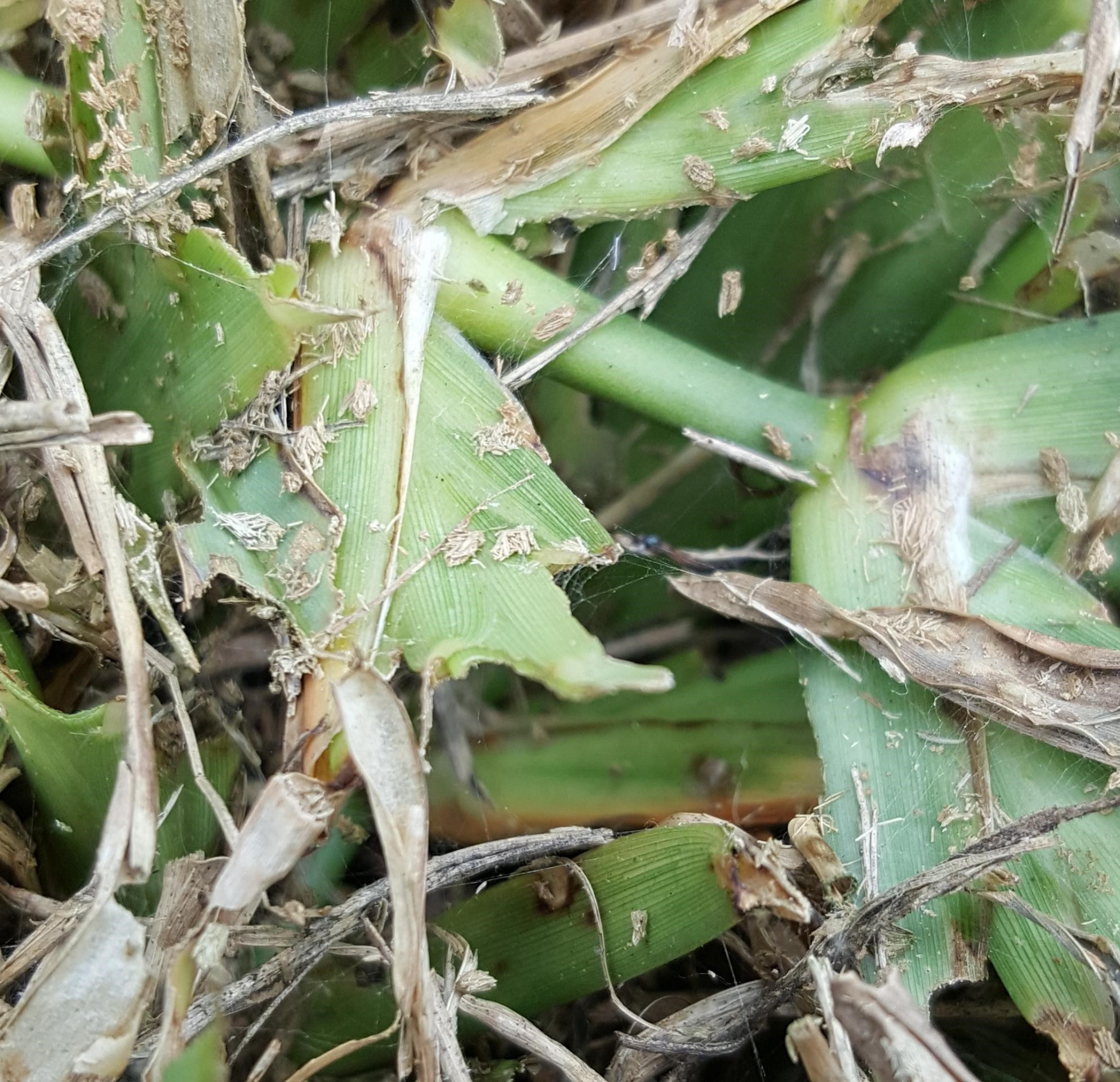
If you see areas where the grass is thinning, kneel down and examine the grass blades for sections being eaten away from the grass blades, and often fecal pellets caught in webbing (see photo). Another good technique is to drench the soil in a spot where you are seeing damage with a solution of 1 tablespoon of lemon-scented liquid dish detergent in one gallon of water. This drench irritates the caterpillars and makes them move up out of the thatch so you can identify the caterpillars (see photo).

If you find you have TSW in your lawn, your options include:
An additional treatment 2-3 weeks later may sometimes be needed. Insecticides effective against caterpillars include Bacillus thuringiensis (B.t.), spinosad, carbaryl (Sevin), and various synthetic pyrethroids (such as bifenthrin and cyfluthrin). Granular formulations fall into the thatch where caterpillars often hide during the day, while liquid formulations remain in the grass blades where caterpillars are feeding. Always check the label for use on turfgrass and follow label instructions carefully regarding mixing and application.
